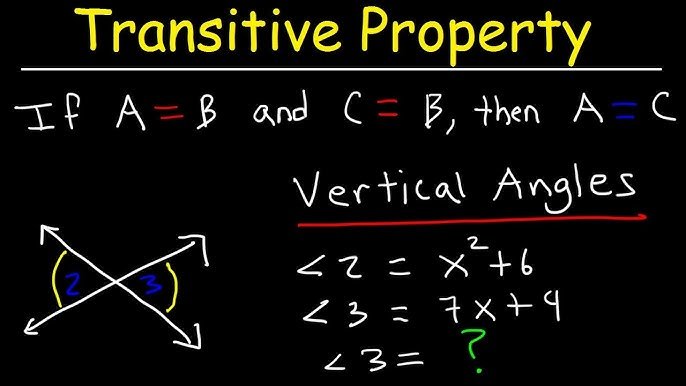
The transitive property is a key concept in mathematics. It is especially important in algebra and geometry. This property helps in understanding relationships between numbers or elements. Let’s dive into what the transitive property is, its applications, and why it matters.
What is the Transitive Property?
The transitive property states that if one thing relates to a second thing, and that second thing relates to a third thing, then the first thing also relates to the third thing. This can be mathematically expressed as:
- If a=b and b=c, then a=c.
This property is clear and direct, making it easy to use in various mathematical contexts.
Key Features of the Transitive Property
Here are some critical features of the transitive property:
- Simplicity: The concept is straightforward and easy to grasp.
- Usefulness: It applies across various mathematical branches, including logic, algebra, and geometry.
- Foundation for Proofs: It serves as a foundational tool for proving other theorems.
Examples of the Transitive Property
- Algebraic Example:
- If x+2=5 and 5=y, then x+2=y.
- Geometric Example:
- If two angles are both equal to a third angle, then the two angles are equal to each other.
- Logical Example:
- If Sarah is taller than John, and John is taller than Mike, then Sarah is taller than Mike.
Applications of the Transitive Property
The transitive property is used in various fields. Here are some ways it finds application:
- In Algebra: When solving equations or inequalities, it helps to simplify and establish relationships.
- In Geometry: It aids in proving congruences of triangles and other figures.
- In Computer Science: It is vital in algorithms and data structures, particularly in relational databases.
Why is the Transitive Property Important?
Understanding the transitive property is crucial for several reasons:
- Logical Reasoning: It enhances logical thinking and reasoning skills.
- Problem Solving: It provides tools for solving complex mathematical problems easily.
- Building Blocks: It serves as a building block for more advanced mathematical concepts.
Engaging with the Transitive Property
To make the concept more relatable, let’s look at some engaging methods of exploring the transitive property:
1. Visual Representations
Use diagrams to illustrate relationships. For instance:
- Draw a triangle showing equal angles and label them to practice the concept visually.
2. Real-World Examples
Identify everyday scenarios that follow the transitive property:
- Friendship Circles: If A is friends with B, and B is friends with C, then A is indirectly friends with C.
3. Interactive Games
Create games or quizzes based on the transitive property. This makes learning fun and interactive!
Conclusion
The transitive property is a fundamental concept in mathematics that reinforces logical relationships. By understanding this property, you improve your problem-solving skills and mathematical reasoning. Whether in algebra, geometry, or real-life situations, the transitive property offers valuable insights.